STEM vs Non-STEM Programs Abroad in 2026: Comparing Post-Study Work Rights, Salary Outcomes & Visa Extensions for Indian Students
STEM vs Non-STEM Programs Abroad in 2026: Comparing Post-Study Work Rights, Salary Outcomes & Visa Extensions for Indian Students
 scholarabroad
 STEM vs Non-STEM Programs Abroad in 2026: What Indian Students Must Know
Estimated Reading Time: 8 minutes
Key Takeaways
- STEM graduates in the USA get 36 months of OPT versus just 12 months for non-STEM graduates, allowing multiple H-1B lottery attempts.
- Canada’s Express Entry now prioritizes STEM occupations, giving STEM graduates an edge in permanent residency even though PGWP rules apply equally.
- STEM starting salaries range from $70,000 to $110,000 in the USA, while non-STEM salaries range from $45,000 to $70,000.
- Non-STEM students can still succeed abroad by choosing countries with flexible work rights, targeting co-op programs, and securing visa-sponsoring employers.
- ROI depends on your career goals, financial capacity, and immigration ambitions — STEM offers a more predictable path, but non-STEM can rival long-term earnings in the right fields.
Table of Contents
- STEM vs Non-STEM Programs Abroad in 2026: What Indian Students Must Know
- Understanding STEM vs Non-STEM
- STEM Designated Programs for International Students
- Post-Study Work Rights: STEM vs Non-STEM
- Salary Outcomes: STEM vs Non-STEM
- Visa Extensions and Immigration Pathways
- Best STEM Courses for International Students 2026
- Non-STEM Study Abroad Career Prospects
- Study Abroad ROI: STEM vs Non-STEM
- How Scholar Abroad Can Help
Choosing between STEM and non-STEM programs abroad is one of the most consequential decisions for Indian students planning to study overseas in 2026. The choice affects not just your academic experience, but your post-study work rights, salary trajectory, and long-term immigration prospects. At Scholar Abroad, we help students navigate these complexities with data-driven guidance. This article breaks down the key differences so you can make an informed decision.
Understanding STEM vs Non-STEM
STEM stands for Science, Technology, Engineering, and Mathematics. Non-STEM encompasses fields like humanities, social sciences, business (in some countries), arts, and education. While both paths offer quality education, the regulatory treatment of graduates differs significantly in popular destinations like the USA, Canada, and the UK.
STEM Designated Programs for International Students
In the USA, STEM-designated programs are those that appear on the Department of Homeland Security’s STEM Designated Degree Program List. Graduates of these programs are eligible for a 24-month extension of their Optional Practical Training (OPT), totaling 36 months of work authorization. Non-STEM graduates are typically limited to 12 months of OPT.
Canada’s Post-Graduation Work Permit (PGWP) does not differentiate between STEM and non-STEM, but recent reforms have introduced field-of-study requirements for some applicants. The UK’s Graduate Route offers 2 years for bachelor’s and master’s graduates, and 3 years for PhD holders, regardless of discipline.
Post-Study Work Rights: STEM vs Non-STEM
United States
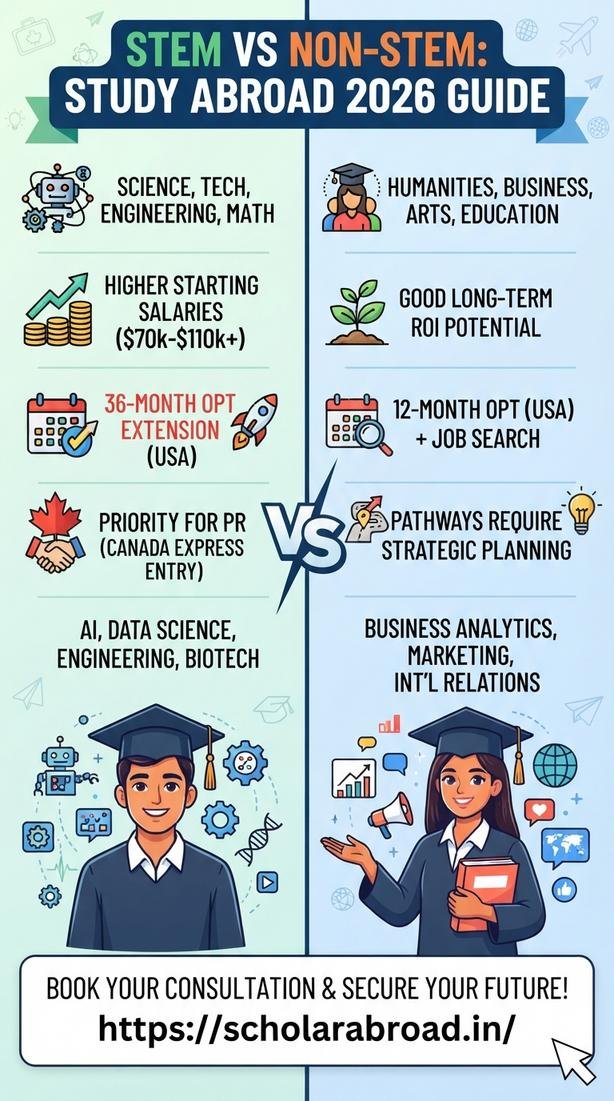
STEM graduates enjoy a clear advantage: 36 months of work authorization versus 12 months for non-STEM. This extra time allows STEM graduates to participate in the H-1B lottery multiple times, significantly increasing their chances of securing long-term work status. For Indian students, this is a critical consideration given the high demand for H-1B visas.
Canada
Canada offers up to 3 years of PGWP for eligible graduates, with no STEM-specific extension. However, Express Entry categories now prioritize STEM occupations, giving STEM graduates an edge in permanent residency applications.
United Kingdom
The UK’s Graduate Route provides 2 years for master’s and bachelor’s graduates, and 3 years for PhDs. While there’s no STEM-specific extension, the Skilled Worker Visa route offers opportunities for both STEM and non-STEM graduates, provided they secure a sponsoring employer.
Salary Outcomes: STEM vs Non-STEM
Data from the US Bureau of Labor Statistics and Canadian Job Bank consistently show that STEM graduates earn higher starting salaries. For Indian students, the difference can be substantial:
- STEM: Average starting salaries range from $70,000 to $110,000 in the USA, depending on the field (computer science, engineering, data science).
- Non-STEM: Average starting salaries range from $45,000 to $70,000, with variations in business, communications, and social sciences.
However, salary is not the only measure of ROI. Non-STEM graduates often find fulfilling careers in education, public policy, media, and management, where long-term earning potential can rival STEM fields.
Visa Extensions and Immigration Pathways
STEM degree visa advantages abroad are most pronounced in the USA. The 24-month OPT extension provides a bridge to H-1B and eventually green card sponsorship. Non-STEM students must rely on the 12-month OPT and a single H-1B attempt, making the path more uncertain.
In Canada, both STEM and non-STEM graduates can access PGWP, but STEM occupations are prioritized in Express Entry. In the UK, the Skilled Worker Visa is open to both, but STEM roles often have higher salary thresholds and demand.
Best STEM Courses for International Students 2026
If you’re considering STEM, these fields offer strong work rights and salary outcomes:
- Computer Science and Artificial Intelligence
- Data Science and Analytics
- Electrical and Mechanical Engineering
- Cybersecurity
- Biotechnology and Biomedical Engineering
These programs are STEM-designated in the USA and align with high-demand occupations in Canada and the UK.
Non-STEM Study Abroad Career Prospects
Non-STEM graduates are not without options. Fields like business analytics, digital marketing, international relations, and public health offer growing opportunities. In Canada, for example, healthcare management and finance are in demand. In the UK, creative industries and education are strong sectors.
However, non-STEM students must be proactive: securing internships, building networks, and targeting employers who sponsor visas. Scholar Abroad advises non-STEM students to choose programs with co-op or internship components to enhance employability.
Study Abroad ROI: STEM vs Non-STEM
When calculating ROI, consider tuition, living costs, and potential earnings. STEM programs often have higher tuition but also higher salary outcomes and longer work rights, improving ROI. Non-STEM programs may have lower tuition but require careful planning to maximize work opportunities.
For Indian students, the decision should align with career goals, financial capacity, and risk tolerance. If your goal is long-term immigration, STEM offers a more predictable path. If you’re passionate about a non-STEM field, choose countries with flexible work rights and strong demand for your skills.
How Scholar Abroad Can Help
At Scholar Abroad, we specialize in helping Indian students choose the right program, country, and visa strategy. Our counselors stay updated on the latest STEM designation lists, work rights, and immigration policies. Whether you’re leaning toward STEM or non-STEM, we provide personalized guidance to maximize your study abroad ROI.
Book a consultation with Scholar Abroad today and take the first step toward a successful international career.