Part-Time Jobs & On-Campus Work for International Students in 2026: Country-Wise Rules, Hour Limits & How to Find Legal Employment Abroad
Part-Time Jobs & On-Campus Work for International Students in 2026: Country-Wise Rules, Hour Limits & How to Find Legal Employment Abroad
 scholarabroad
 Can You Work Part-Time While Studying Abroad in 2026? Yes — But the Rules Matter
Estimated reading time: 9 minutes
Key Takeaways
- Part-time work is legal in most study destinations — but every country sets its own student visa work hour limits.
- The 20 hours work rule student visa is the most common cap, though Canada (24 hours) and New Zealand (25 hours) have raised limits for 2026.
- On-campus jobs for international students are the safest option and are often exempt from weekly hour caps.
- Violating work rules can jeopardize your visa, your degree, and future immigration applications.
- International student employment rights 2026 should be understood before you leave home — not after a problem arises.
Table of Contents
- Why Working Abroad Is More Than Just Extra Cash
- Country-Wise Work Rules for International Students in 2026
- The 20-Hour Rule: What It Really Means
- How to Find On-Campus Jobs for International Students
- How to Find Off-Campus Part-Time Jobs Legally
- Red Flags: What Not to Do
- How Scholar Abroad Helps You Work While Studying Abroad Legally
- Final Thoughts: Earn, Learn, and Stay Compliant
Every year, thousands of Indian students head overseas with big academic dreams — and even bigger living expenses. Tuition is only part of the picture; rent, food, transport, and health insurance add up fast. That’s why part-time jobs for international students in 2026 are not just a nice-to-have. They are often a financial lifeline.
But here’s the catch: every country has its own student visa work hour limits, and breaking them can put your visa — and your degree — at risk. At Scholar Abroad, we help students navigate these rules before they even land. This guide breaks down country-wise work regulations, the 20-hour rule, how to find on-campus jobs for international students, and how to stay 100% legal while earning.
Why Working Abroad Is More Than Just Extra Cash
Legal part-time work offers three big wins:
- Financial relief: Offset living costs and reduce dependence on loans.
- Career exposure: Gain local work experience, references, and industry contacts.
- Language & cultural fluency: Nothing speeds up adaptation like a real workplace.
But the keyword here is legal. International student employment rights 2026 are strict, and ignorance is not a defense. Let’s look at the rules by country.
Country-Wise Work Rules for International Students in 2026
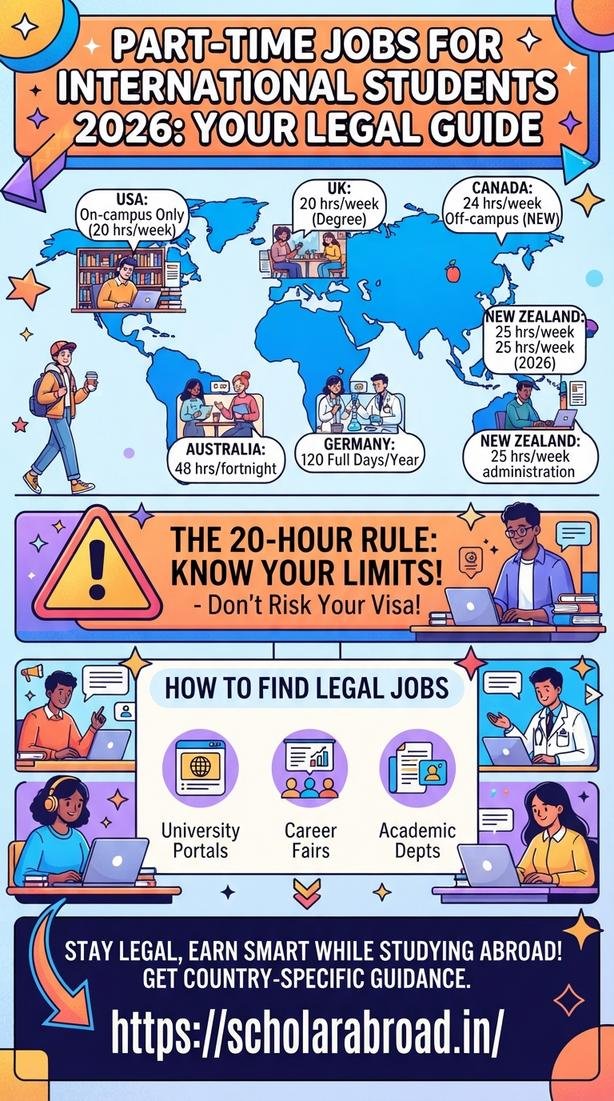
United States: On-Campus First, Then CPT/OPT
F-1 visa students can work on-campus up to 20 hours per week during semesters and full-time during breaks. Off-campus work is generally not allowed unless it’s Curricular Practical Training (CPT) or Optional Practical Training (OPT). The 20 hours work rule student visa applies strictly here — exceed it, and you risk status violation.
United Kingdom: 20 Hours for Degree Students
If you’re on a Student Route visa at a degree level, you can work 20 hours per week during term time and full-time during holidays. Below degree level? Only 10 hours. No self-employment, no freelance gigs, no permanent full-time roles.
Canada: 24 Hours Off-Campus (2026 Update)
Canada now allows eligible international students to work up to 24 hours per week off-campus during academic sessions — a major boost from the old 20-hour cap. On-campus work has no weekly limit. But you must be enrolled full-time and have a valid study permit with the right conditions.
Australia: 48 Hours Per Fortnight
Student visa holders can work 48 hours per fortnight once their course has started. That’s roughly 24 hours per week. During course breaks, there’s no limit. Always check your visa grant letter — conditions can vary.
Germany: 120 Full or 240 Half Days Per Year
Non-EU students can work 120 full days or 240 half days per year. On-campus jobs are often exempt from this limit. After graduation, you can apply for an 18-month job-seeking visa.
New Zealand: 25 Hours During Semesters (2026)
From 2026, eligible students can work up to 25 hours per week during semesters and full-time during scheduled breaks. This applies to degree-level and certain sub-degree programs.
The 20-Hour Rule: What It Really Means
The 20 hours work rule student visa is the most common cap worldwide — but it’s often misunderstood. It usually refers to paid work during term time, not voluntary work, and not always on-campus work. Some countries count hours per week; others per fortnight. Some exclude on-campus jobs entirely from the limit.
At Scholar Abroad, we always tell students: read your visa conditions, not just the headlines. A 24-hour week in Canada is legal; the same in the US on an F-1 visa is not.
How to Find On-Campus Jobs for International Students
On-campus jobs are the safest bet for new arrivals. They’re usually flexible, close to classes, and designed for students. Here’s where to look:
1. University Job Portals
Most universities have a dedicated student employment page. Bookmark it and check weekly. Roles include library assistant, cafeteria staff, gym attendant, IT support, and research assistant.
2. International Student Office
This office often has a list of approved on-campus employers and can confirm your work eligibility in writing. Build a relationship early.
3. Academic Departments
Professors often hire students for grading, lab assistance, or event support. A polite email with your CV can go a long way.
4. Career Fairs & Orientation Events
Many campuses run part-time job fairs during the first two weeks of semester. Attend them — even if you don’t have a job yet.
How to Find Off-Campus Part-Time Jobs Legally
If your visa allows off-campus work, you can look beyond campus. Popular options include retail, hospitality, tutoring, delivery, and freelance work (only if self-employment is permitted).
Useful platforms: Indeed, LinkedIn, StudentJob, and local Facebook groups. But always verify the employer understands student visa restrictions. Never start work before you have written confirmation of your hours and legal status.
Red Flags: What Not to Do
We’ve seen too many students fall into traps. Avoid these:
- Working more than your visa allows — even “just once.”
- Taking cash-in-hand jobs with no contract.
- Freelancing or gig work without checking if it’s allowed.
- Starting work before your course begins or after it ends (unless you have post-study work rights).
- Assuming on-campus jobs are unlimited — they’re not always.
How Scholar Abroad Helps You Work While Studying Abroad Legally
At Scholar Abroad, we don’t just help you get admitted. We prepare you for the real-life side of studying overseas — including how to work while studying abroad legally. Our counselors provide:
- Country-specific guidance on work hour limits and visa conditions.
- Pre-departure webinars on finding on-campus and off-campus jobs.
- CV and cover letter reviews tailored to student jobs.
- Connections with alumni who’ve successfully worked part-time abroad.
- Ongoing support if you face employer issues or visa questions.
We believe international student employment rights 2026 should be understood before you board the flight, not after a problem arises.
Final Thoughts: Earn, Learn, and Stay Compliant
Part-time work can transform your study abroad experience — reducing financial stress, building your resume, and helping you integrate. But the rules change by country and by year. As we move through 2026, stay updated through official government sources and your university’s international office.
If you’re an Indian student planning to earn while studying abroad, start with the right information. Talk to Scholar Abroad and let us help you find legal, sustainable part-time work that fits your visa, your schedule, and your goals.