AI & Data Science vs. Traditional Engineering in 2026: The Master’s Path Abroad That Future-Proofs Your Career
AI & Data Science vs. Traditional Engineering in 2026: The Master’s Path Abroad That Future-Proofs Your Career
 scholarabroad
AI & Data Science vs. Traditional Engineering in 2026: The Master’s Path Abroad That Future-Proofs Your Career
Estimated reading time: 8 minutes
Key Takeaways
- AI and data science master’s degrees offer the fastest route to high-paying, high-demand roles across every industry.
- Traditional engineering (electrical, mechanical, civil) still delivers structural demand, licensure stability, and deep specialization.
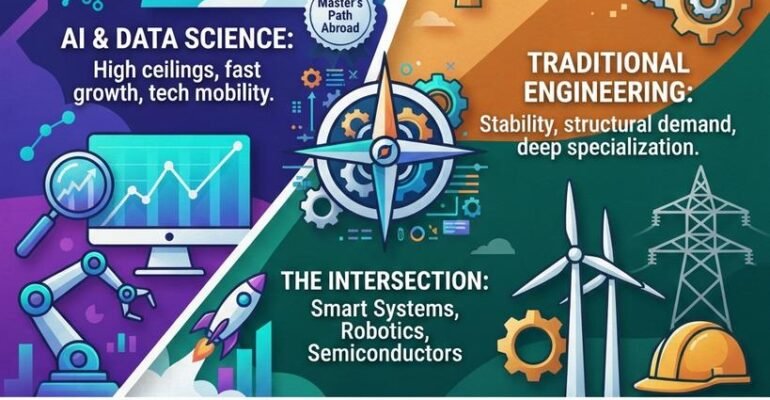
- The smartest, most future-proof careers often sit at the intersection—like AI applied to electrical systems or data science for manufacturing.
- ROI should factor tuition, living costs, post-study work rights, and salary trajectories—not just starting pay.
- Honest comparison, early planning, and outcome-aligned program selection protect your investment.
Table of Contents
- Why 2026 Is a Genuine Turning Point
- The Case for AI & Data Science Master’s Programs Abroad
- The Enduring Value of Traditional Engineering Abroad
- STEM Master’s ROI Comparison: What the Numbers Suggest
- The Smartest Choice: Hybrid and Intersection Paths
- How Scholar Abroad Helps You Decide
- Final Takeaway
Why 2026 Is a Genuine Turning Point
For thousands of Indian students, a master’s abroad is more than a degree—it’s a career-defining investment. But by 2026, the decision has grown sharper: do you pursue AI and data science, or stay with a traditional engineering discipline like electrical, mechanical, or civil? Both paths lead abroad, but they lead to very different futures. This guide breaks down the trade-offs so you can choose with clarity rather than hype.
Hiring has shifted. Employers now prize graduates who can work with data, automate workflows, and deploy intelligent systems. At the same time, the world still needs engineers to build chips, power grids, and resilient infrastructure. The real question isn’t which field is “better”—it’s which one fits your strengths, budget, and long-term goals.
The Case for AI & Data Science Master’s Programs Abroad
AI and data science master’s degrees have become the fastest route to high-paying, high-demand roles. Universities in the USA, UK, Canada, and Germany now offer specialized programs in machine learning, applied AI, and data engineering.
Where the Demand Is Coming From
- Every industry is hiring: Healthcare, finance, logistics, and manufacturing all need data talent.
- Strong salary ceilings: Data scientists and ML engineers consistently rank among the highest-paying roles for international graduates.
- Flexible career mobility: Skills transfer across sectors and geographies more easily than many traditional engineering roles.
What to Watch Out For
AI programs are competitive and mathematically demanding. Fields like deep learning require solid foundations in statistics and programming. Also, not every “AI” program is created equal—curriculum quality and industry links matter enormously.
The Enduring Value of Traditional Engineering Abroad
Traditional engineering hasn’t lost its edge—it has quietly become more valuable in specific niches. Electrical engineering, for example, is enjoying a resurgence thanks to semiconductors, electric vehicles, and renewable energy.
Why Traditional Paths Still Pay Off
- Structural demand: The global chip shortage and energy transition created a talent gap in electrical and power engineering.
- Licensure and stability: Certain roles require accredited engineering credentials, protecting your position.
- Deep specialization: Mechanical, civil, and aerospace engineering offer clear career ladders and long-term stability.
The Reality Check
Some traditional specializations face slower salary growth and automation pressure. Choosing a traditional path without a modern angle—like smart grids or robotics—can limit your upside.
STEM Master’s ROI Comparison: What the Numbers Suggest
When comparing AI and data science vs traditional engineering in 2026, ROI should include tuition, living costs, post-study work rights, and salary trajectories—not just starting pay.
| Factor | AI & Data Science | Traditional Engineering |
|---|---|---|
| Starting salaries | Higher on average | Moderate to high, niche-dependent |
| Program competitiveness | Very high | Moderate |
| Work visa pathways | Strong in tech hubs | Strong in engineering-shortage sectors |
| Long-term ceiling | Very high | Stable, specialization-dependent |
For many Indian students, the highest-paying engineering master’s abroad tends to sit at the intersection—like AI applied to electrical systems or data science for manufacturing.
The Smartest Choice: Hybrid and Intersection Paths
The binary framing of AI vs traditional engineering is outdated. The most future-proof careers after study abroad often blend both: robotics, autonomous systems, semiconductor data analytics, and smart infrastructure. If you’re weighing data science vs electrical engineering abroad, consider programs that combine them.
Questions to Ask Before You Apply
- Does the curriculum include hands-on industry projects?
- What are the post-study work rights in that country?
- How strong is the university’s alumni network in your target sector?
- What is the realistic total cost, including living expenses?
How Scholar Abroad Helps You Decide
At Scholar Abroad, we help Indian students move beyond generic rankings and choose programs aligned with real career outcomes. From shortlisting the best master’s programs abroad for Indian students in 2026 to evaluating ROI and visa pathways, our counselors bring clarity to a high-stakes decision. Whether you lean toward AI or a specialized traditional track, we help you build a study abroad plan that protects your investment.
Final Takeaway
There is no universal winner in the AI and data science vs traditional engineering debate. AI offers higher ceilings and flexibility; traditional engineering offers stability and niche demand. The future-proof choice is the one that matches your aptitude, budget, and career vision—and is backed by careful research. Start early, compare honestly, and choose a path you can defend for the next decade.
Ready to find your ideal program? Talk to Scholar Abroad today and turn your master’s ambitions into a clear, confident plan.