Blocked Account, GIC & Proof of Funds in 2026: Country-Wise Financial Documentation Guide for Indian Students
Blocked Account, GIC & Proof of Funds in 2026: Country-Wise Financial Documentation Guide for Indian Students
 scholarabroad
Blocked Account, GIC & Proof of Funds in 2026: A Country-Wise Financial Documentation Guide for Indian Students
Estimated reading time: 9 minutes
Key Takeaways
- Financial documentation—not grades or interviews—is the single biggest cause of study visa rejections for Indian students.
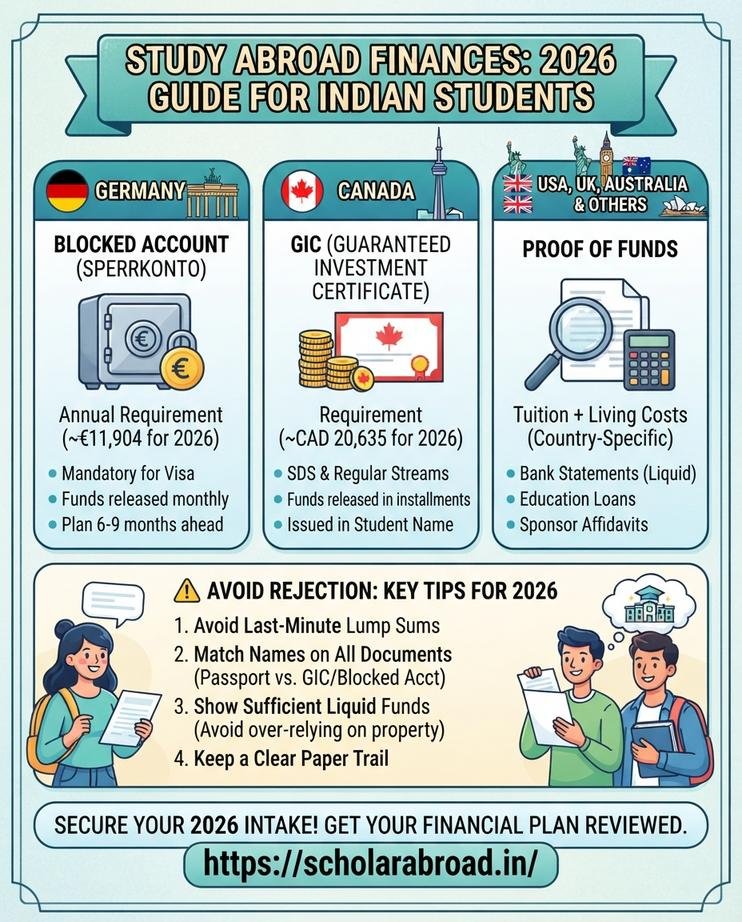
- Germany requires a blocked account (~€11,904 for 2026), Canada requires a GIC (CAD 20,635 + tuition), while the US, UK, and Australia rely on broader proof of funds.
- Name matching, fund liquidity, and a clean paper trail matter more than the total balance.
- Start financial planning 6–9 months early to avoid red-flag lump-sum deposits.
- A country-specific file audit before submission dramatically reduces rejection risk.
Table of Contents
- Why Financial Documentation Causes Visa Rejections
- Blocked Account vs GIC vs Proof of Funds: What’s the Difference?
- Country-Wise Financial Requirements for 2026
- The 2026 Student Visa Financial Documents Checklist (India)
- How Much Bank Balance Do You Actually Need?
- How to Avoid Visa Rejection on Proof of Funds
- How Scholar Abroad Helps You Get It Right
Why Financial Documentation Causes Visa Rejections
Every year, thousands of Indian students receive admission offers from top global universities—only to see their dreams derailed by a study visa rejection. And in the overwhelming majority of cases, the culprit isn’t grades, language scores, or interview performance. It’s financial documentation.
As 2026 brings stricter verification standards, digital financial checks, and updated country-specific thresholds, getting your proof of funds right has never been more critical. At Scholar Abroad, we’ve guided countless students through this exact maze. This guide breaks down blocked accounts, GICs, and proof of funds—country by country—so you can submit a financial file that clears the first time.
Visa officers assess one core question: Can this student fund their entire study period without working illegally or running out of money? Common rejection triggers include:
- Funds held in the wrong account type (e.g., a regular savings account where a blocked account is mandatory)
- Insufficient balance against 2026-updated thresholds
- Unexplained lump-sum deposits shortly before application
- Missing sponsor affidavits or relationship proof
- Invalid education loan sanction letters
Understanding how to show financial documentation for study abroad correctly is not optional—it’s the backbone of your visa application.
Blocked Account vs GIC vs Proof of Funds: What’s the Difference?
Before going country-wise, let’s decode the three terms students most often confuse:
1. Blocked Account (Sperrkonto)
A special account—most famously required by Germany—where you deposit a fixed amount that cannot be freely withdrawn. Funds are released monthly after arrival, proving you can sustain yourself throughout your studies.
2. GIC (Guaranteed Investment Certificate)
A Canada-specific requirement under the SDS (Student Direct Stream) and now standard study permit processing. You purchase a GIC from a participating Canadian bank; funds are released in installments after you land.
3. Proof of Funds
A broader requirement for the US, UK, Australia, and most other destinations—bank statements, sponsor affidavits, loan approvals, or fixed deposits demonstrating sufficient balance.
Country-Wise Financial Requirements for 2026
Germany: Blocked Account for Indian Students
The blocked account for study abroad 2026 in Germany remains the gold standard of financial proof. For 2026, expect the annual requirement to hover around €11,904 (approximately ₹10.7–11 lakh), released at roughly €992/month. Indian students must open the account through Fintiba, Expatrio, Coracle, or similar providers before visa application—not after. Scholar Abroad assists with provider selection, forex timing, and remittance documentation to avoid last-minute transfer issues.
Canada: GIC for Study Permit 2026
The GIC for Canada study permit 2026 typically requires CAD 20,635 (updated annually with cost-of-living adjustments) plus first-year tuition proof. Indian students open GICs through Scotiabank, CIBC, ICICI Bank Canada, or SBI Canada. Critical tip: ensure the GIC is issued in the student’s name, and pair it with a tuition payment receipt and sponsor affidavit if a parent is funding you. Mismatched names remain a silent rejection killer.
United States: Proof of Funds via I-20
The US doesn’t use blocked accounts or GICs. Instead, your university issues an I-20 based on proof of funds for student visa covering tuition plus living costs (often ₹35–60 lakh/year). Acceptable evidence: bank statements (3–6 months old), fixed deposits, education loan sanction letters, sponsor affidavits with ITRs, and property valuations in some cases. Visa officers at the consulate scrutinize liquidity—FDs are fine, but they must be readily accessible.
United Kingdom: 28-Day Bank Balance Rule
The UK requires funds held for 28 consecutive days before application, covering tuition plus 9 months of living costs (£1,136/month in London, £1,023 elsewhere). Bank statements must be dated within 31 days of application. One wrong date and your CAS-linked financial proof collapses.
Australia: Genuine Student Financial Capacity
Australia’s Genuine Student (GS) framework demands evidence of AUD 29,710+ for living costs plus tuition and travel. Savings history, sponsor income proof, and loan approvals are all scrutinized under the newer, stricter assessment regime.
The 2026 Student Visa Financial Documents Checklist (India)
Regardless of destination, your student visa financial documents checklist India should include:
- Bank statements (6 months, stamped by the bank)
- Blocked account confirmation or GIC certificate (destination-specific)
- Sponsor affidavit for study abroad visa (on stamp paper, notarized)
- Sponsor’s ITRs (2–3 years) and employment/business proof
- Education loan proof for student visa (sanction letter + disbursement schedule)
- Forex remittance receipts for tuition and blocked accounts
- Passport, admission letter, and fee payment receipts
How Much Bank Balance Do You Actually Need?
The honest answer: it depends on country, city, course duration, and dependents. But the study abroad financial requirement by country 2026 can be summarized as:
- Germany: ~€11,904/year (blocked account)
- Canada: CAD 20,635 (GIC) + tuition
- UK: Tuition + £10,224–£13,632 living costs
- Australia: AUD 29,710 + tuition
- USA: Full I-20 amount (varies widely)
Always check the latest embassy guidelines—thresholds change every intake cycle.
How to Avoid Visa Rejection on Proof of Funds
To avoid visa rejection proof of funds issues in 2026:
- Start financial planning 6–9 months early. Sudden lump sums raise red flags.
- Match document names exactly. Student name on GIC/blocked account must match passport.
- Don’t over-rely on property. Liquid funds win over illiquid assets.
- Get loan letters vetted. Not all sanction letters are accepted—format matters.
- Keep a paper trail. Every rupee in your account should have an explainable source.
How Scholar Abroad Helps You Get It Right
Financial documentation isn’t just paperwork—it’s strategy. Scholar Abroad visa financial assistance covers blocked account setup, GIC guidance, loan coordination, sponsor affidavit drafting, and country-specific file audits before submission. Our counselors stay updated on 2026 embassy norms so your application reflects exactly what visa officers expect to see.
Don’t let a documentation error cost you your global education. Book a financial documentation review with Scholar Abroad today—and step into your 2026 intake with confidence.