India’s Student Visa Rejection Crisis 2026: How Canada, Australia & UK Policy Shifts Are Reshaping Study Abroad Plans
India’s Student Visa Rejection Crisis 2026: How Canada, Australia & UK Policy Shifts Are Reshaping Study Abroad Plans
 scholarabroad
 India’s Student Visa Rejection Crisis 2026: How Canada, Australia & UK Policy Shifts Are Reshaping Study Abroad Plans
Estimated reading time: 8 minutes
Key Takeaways
- Canada, Australia, and the UK have all introduced stricter student visa policies in 2024-2026, leading to significantly higher rejection rates for Indian applicants.
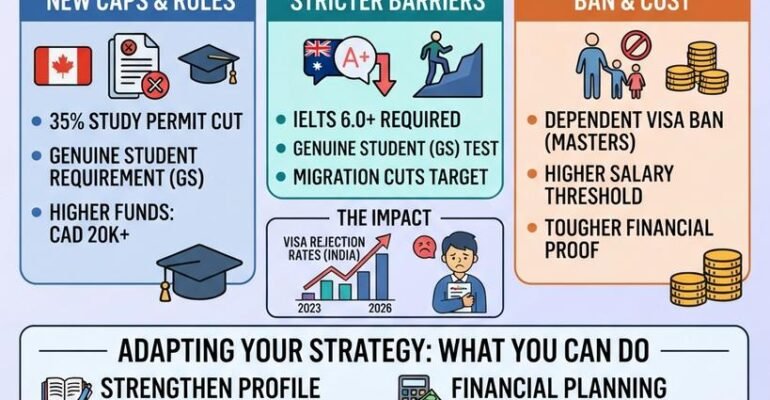
- Canada’s study permit cap reduced new international student visas by 35%, while financial requirements increased to CAD 20,635.
- Australia raised English language requirements to IELTS 6.0 and introduced the Genuine Student requirement with financial proof of AUD 29,710.
- The UK banned dependents on taught master’s courses and raised the skilled worker visa salary threshold to £38,700.
- Alternative destinations like Germany, Ireland, New Zealand, and Singapore are emerging as attractive options with more favorable policies.
Table of Contents
- India’s Student Visa Rejection Crisis 2026
- Key Takeaways
- The 2026 Policy Shift: A Perfect Storm
- Canada: The Study Permit Cap and Its Ripple Effects
- Australia: Higher English Requirements and the Genuine Student Test
- UK: The Dependent Visa Crackdown and Higher Salary Thresholds
- The Impact on Indian Students: Rejections and Recalculations
- Adapting Your Strategy: What You Can Do
- The Road Ahead: Opportunities in Adversity
For decades, Indian students have been the backbone of international education, contributing billions to the economies of Canada, Australia, and the UK. But 2026 marks a turning point. A combination of stricter immigration policies, economic pressures, and geopolitical shifts has led to a dramatic rise in student visa rejection rates for Indian applicants. As we navigate this new landscape, it’s crucial to understand the driving forces behind these changes and how they are reshaping study abroad plans for thousands of Indian students.
At Scholar Abroad, we’ve been closely monitoring these developments. Our mission is to empower students with accurate, timely information and strategic guidance to overcome these hurdles. In this article, we’ll dissect the policy shifts in three major destinations—Canada, Australia, and the UK—and explore what they mean for your overseas education dreams in 2026 and beyond.
The 2026 Policy Shift: A Perfect Storm
The surge in visa rejections isn’t arbitrary. It’s the result of deliberate policy changes aimed at curbing immigration and ensuring that international students genuinely intend to study, not work. Governments are responding to domestic pressures: housing shortages, inflation, and political narratives that blame immigrants for economic woes. For Indian students, this means higher scrutiny, tougher financial requirements, and a more complex application process.
Canada: The Study Permit Cap and Its Ripple Effects
Canada has long been a top choice for Indian students due to its post-graduation work permit (PGWP) and pathways to permanent residency. However, in 2024, Canada introduced a two-year cap on study permits, reducing the number of new international student visas by 35%. For 2026, the cap remains in place, with provinces allocated quotas based on population and infrastructure. Additionally, the introduction of the Genuine Student Requirement (GS) in 2024 (replacing the GTE) has made it harder for applicants to prove their intent to study. The financial requirement has also increased to CAD 20,635 (excluding tuition) for a single applicant, up from CAD 10,000.
These changes have led to a sharp decline in approvals for Indian students, especially those applying to colleges with questionable track records. The message is clear: Canada wants genuine students, not economic migrants. For applicants, this means meticulous documentation, a clear study plan, and proof of funds.
Australia: Higher English Requirements and the Genuine Student Test
Australia has similarly tightened its student visa rules. In 2024, the government increased the minimum English language requirement for student visas from IELTS 5.5 to 6.0, and for temporary graduate visas from 6.0 to 6.5. The Genuine Student (GS) requirement replaced the GTE in 2024, requiring a 500-word statement addressing the applicant’s background, study intentions, and value of the course. The financial requirement has also been raised to AUD 29,710.
Furthermore, Australia’s Migration Strategy aims to cut net migration by 50% by 2025, with international students a key target. For Indian students, this translates to higher rejection rates, particularly for those applying to vocational courses or with gaps in their academic history.
UK: The Dependent Visa Crackdown and Higher Salary Thresholds
The UK has been the most aggressive in restricting student visas. In 2024, the government banned international students from bringing dependents (spouses and children) on taught master’s courses, unless they are on research-based programs. This directly impacted Indian students, who often bring family members. The salary threshold for skilled worker visas was also raised to £38,700, making it harder for graduates to switch to work visas.
Additionally, the UK’s Student Route now requires stricter proof of funds and a more rigorous credibility interview. The result? A significant drop in Indian student applications and approvals. The UK’s loss is other countries’ gain, as students look for more welcoming destinations.
The Impact on Indian Students: Rejections and Recalculations
The data is sobering. According to recent reports, Canada’s student visa rejection rate for Indian applicants rose from 38% in 2023 to over 50% in 2024, and early 2026 trends suggest a similar trajectory. Australia’s rejection rate for Indian students climbed to 25%, while the UK saw a 20% increase in refusals.
These numbers have a profound impact. Students who had already invested time and money in applications are facing uncertainty. Many are deferring admissions, switching destinations, or abandoning overseas education altogether. The psychological and financial toll is immense. But where there are challenges, there are also opportunities.
Adapting Your Strategy: What You Can Do
At Scholar Abroad, we believe that with the right strategy, you can still achieve your study abroad dreams. Here’s how:
- Strengthen Your Profile: Focus on academics, English proficiency, and a clear study plan. The GS requirement demands a well-articulated statement of purpose.
- Choose the Right Course and Institution: Avoid low-quality colleges. Select programs that align with your career goals and are offered by reputable institutions.
- Financial Documentation: Ensure you have sufficient funds and can prove their source. Consider education loans or sponsorships.
- Consider Alternatives: Countries like Germany, Ireland, New Zealand, and Singapore are emerging as attractive alternatives with more lenient policies and strong post-study work opportunities.
- Seek Expert Guidance: Work with certified consultants who understand the nuances of each country’s visa process.
The Road Ahead: Opportunities in Adversity
While Canada, Australia, and the UK tighten their belts, other destinations are rolling out the red carpet. Germany, with its tuition-free public universities and new Opportunity Card, is gaining popularity. Ireland offers a two-year stay-back for master’s graduates. New Zealand and Singapore have relatively stable policies. Additionally, Asian and European countries are expanding their English-taught programs.
For Indian students, this is a time to be strategic. The era of easy visas is over; the era of smart choices has begun. By diversifying destinations and preparing thoroughly, you can still secure a world-class education.
Scholar Abroad is here to guide you every step of the way. Our team of experts stays updated on the latest policy changes and can help you build a winning application. Whether you’re targeting Canada, Australia, the UK, or exploring new horizons, we provide personalized counseling, application support, and visa assistance.
Don’t let policy shifts derail your dreams. Contact us today to chart a course for your global future.